Mera Samarth Bharat (MSB)
“Samarth” is determined to work with focused efforts towards the enrichment and growth of our Nation, under the guiding light of our patrons as well as our age-old heritage of “PARAMARTH” and “PURUSHARTH”.
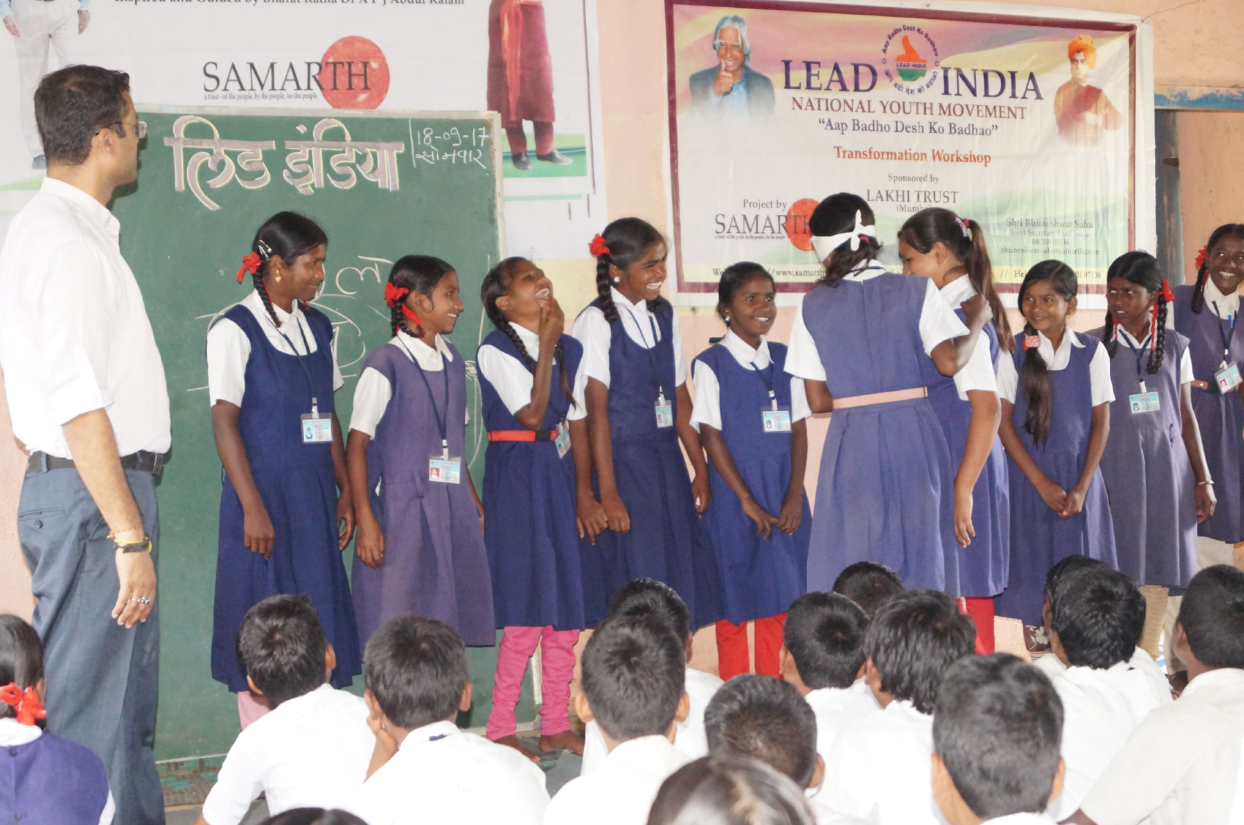
MSB is to impart life skills, thinking skills, global skills, positive attitude with vision, mission and inculcating values, social responsibilities and ignite the minds among the focused age group of 10 to 17 years. The modules will be introduced to children from 6th class onwards. The design of the program encourages peer learning and thus ensures continuity and sustainability of the training module and is kept operative for a long term.
The program is designed keeping in focus STUDENTS, YOUTHS PARENTS and TEACHERS. It is designed to impart and develop Life and leadership skills, Positive attitude with Vision and Mission, inculcating ethics and values, social responsibility and living life with a Specific Goal and direction.
Features of MSB
Every student connects with his duties and responsibilities towards the society and nation
Participation in national programs as per personal hobbies and interests
Development of citizens who can usher in transformation and sustainable development in the country
Overall economic development because of Human Development and National Orientation
With the progress of the program, the Potential Leaders are developed for appropriate mentorship.
Vision & Mission
Vision
Prosperity, Excellence and Spirituality
Mission
Facilitating a holistic environment for nation building through individual development
MSB Workshops
-
›
Acharya Devo Bhava (48 days in 4 years residential)
-
›
Inspiration Aspiration Sustainable (IAS) — 12 days in 1 year (Non-residential)
-
›
Matru Devo Bhava Pitru Devo Bhava — 5 hours in 3 months
-
›
Bharat Parivar Workshop — 2 days
-
›
Inspiring Minds — 1 day (Residential / Non-residential)
-
›
TVT — 2 days (Non-residential)
-
›
BRT — 1 day (Non-residential)
-
›
DIT — 1 day (Non-residential)
-
›
Learning Life Leadership (3L) — 2 hours
-
›
Youth Leadership Camp (YLC) — 4 days (Residential)
-
›
Leadership Orientation Camp (LOC) — 30 days (Residential)
-
›
Leadership Establishment Camp (LEC) — 51 days
-
›
Leadership Vision Development Program (LVDP) — 11 days
-
›
Ignited Minds — 7 days (Residential)
-
›
Non Cluster Level Make Leader — 30 hours (Residential)
-
›
Cluster Level Atma Deepo Bhava — 30 hours (Non-Residential)
-
›
School Level Little Leader Little Teacher — 7 to 10 days (Residential)
-
›
District Level Mera Samarth Bharat Camp — 15 days (Residential)
-
›
State Level Life and Vision Camp — 21 days (Residential, Once a Year)
-
›
National Level — Once a Year
MSB Outcomes
1.1. Education Provides the Knowledge to live
1.2. Knowledge with which life can be celebrated
1.3. They can live with excellence
1.4. They can live in prosperity
1.5. They can find gratification in relationships
1.6. They can be partner in the systems of society
2.1. School is a place for discussion correction, motivation and what is needed in society
2.2. Every child has the right to commit mistakes and the opportunity to correct each other
2.3. Children are performers and Teachers are facilitators, motivators and supervisors
2.4. Teachers’ role is a facilitator in the beginning and partner in possibility in long term
2.5. Anything good done by child is celebrated by the whole school
3.1. Age is not a bar for students to study in a class
3.2. Decreased load of bags of children
3.3. Decreased pressure on teachers
3.4. Energy of student is channelized
3.5. Free students from imprisonment of books
3.6. Holistic development of child
3.7. Make students rational
3.8. Makes child skillful with values
3.9. No child is left behind
3.10. Participation of each child is well defined
4.1. Team building open environment (Bully Free Class)
4.2. Child develops regular Planning habits
4.3. Play and learn to help students to learn with Joy.
4.4. Reduced bag-load of children
4.5. Each child is capable of self-assessment
4.6. Each child is different R and D is created to understand each child
4.7. Each child is teacher here who teaches others
4.8. Each child understands right utilization of resources
4.9. Fast, accurate, stress-free notes making by learning shorthand from 2nd grade
4.10. Inculcates good habits though right understanding
4.11. Involvement of different stakeholders in school (LINK)
4.12. Make each child healthy
4.13. Make each child responsible
4.14. Make each child social and self -confident
4.15. Make each child technology friendly
4.16. Make each student socially strong
4.17. Do homework interesting
4.18. Only discuss good things done by Child
4.19. Removes fear of math
4.20. Minimum role of faculty and Maximum role of students
4.21. Little leader little teacher student ratio is 10 :1
4.22. Values are defined
5.1. A better Self
5.2. Child parliamentary system
5.3. Socially strong
5.4. Buddy system
5.5. Gyan mela
5.6. Am I able
5.7. Self-competition
5.8. After I am educated
5.9. Skill to understand life
5.10. Logical and analytical reasoning
5.11. Brain mapping
5.12. Swastha bharat
5.12.1. First aid
5.12.2. CPR
5.12.3. Acupressure
5.12.4. Home remides
5.12.5. Teeth and stomach relation
5.13. Surakshit bharat
5.13.1. Disaster management
5.13.2. Law
5.13.3. Traffic rules
5.13.4. Children court
5.14. Swachh bharat
5.14.1. Garbage disposal
5.14.2. Handling of water
5.15. Samruddh bharat
5.15.1. Children bank
5.15.2. Re-use of books and notebooks
5.16. Gauravshali bharat
5.16.1. Bharat bodh